Downloads

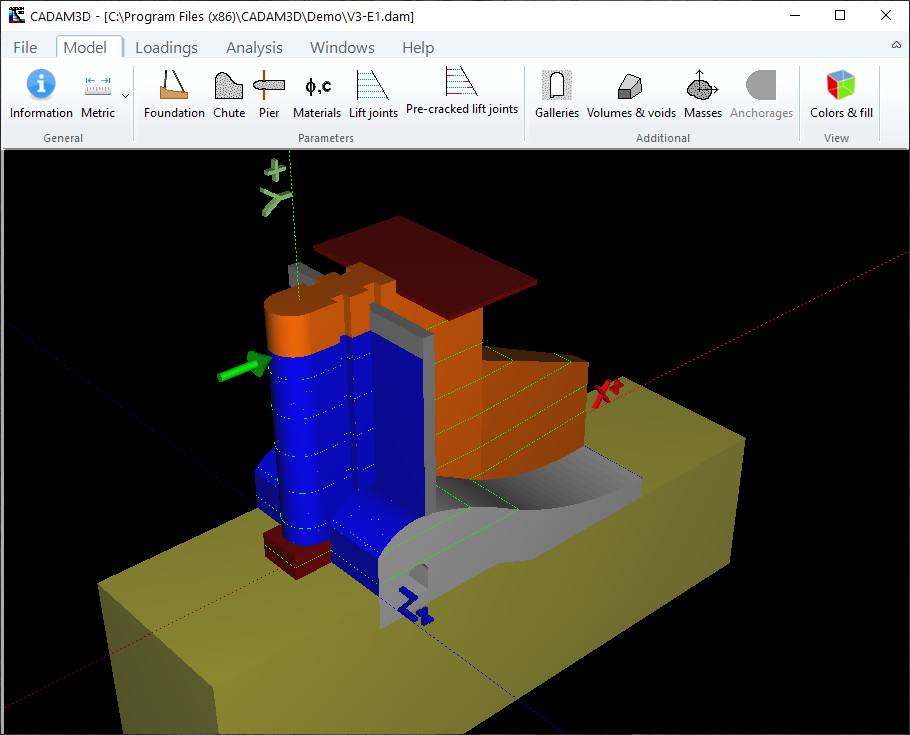
CADAM3D is a user-friendly software based on the gravity method originally developed for one of the world biggest concrete dam owner, Hydro-Quebec, and for Dams and Hydrology of the Quebec Ministry of Environment (Quebec's legislator for dam safety). CADAM3D is fully functional and is intensively used by Hydro-Quebec since 2005. To our knowledge, no other software similar to CADAM3D is available at this time.
If you perform stability analyzes of concrete hydraulic structures, this software will allow you to perform them much faster and more efficiently. If you are interested in this type of software and would like to try CADAM3D for free, please click on the button "Contact us for a free trial of CADAM3D" to send us a message.
The medium through which content is delivered has also transformed the nature of its influence. The rise of digital and social media platforms like TikTok, YouTube, and Netflix has fragmented the once-unified popular culture. Whereas a single episode of M A S H* or The Cosby Show could command the attention of nearly 40% of American households in the 1980s, today’s audience is splintered into countless niche communities. This fragmentation has a dual effect. On one hand, it allows for greater diversity and personalization; a fan of Korean drama, amateur woodworking, or obscure synthwave music can easily find a thriving community. On the other hand, it has led to the creation of "echo chambers," where algorithms feed users content that reinforces their existing beliefs, potentially deepening political and cultural polarization. The power to mold is no longer held solely by a few Hollywood studios but is distributed among billions of users acting as both consumers and creators.
Of course, this immense power carries significant responsibilities and dangers. The unregulated nature of much online entertainment content has led to concerns about misinformation, cyberbullying, and the glorification of harmful behaviors. The pressure to conform to digitally altered and often unattainable standards of beauty has been linked to rising rates of anxiety and depression, particularly among adolescent girls. Furthermore, the addictive design of many social media and gaming platforms, engineered to maximize "engagement" and screen time, raises critical questions about free will and mental health. As entertainment becomes increasingly immersive through virtual and augmented reality, these ethical challenges will only intensify. xxxcomics
At its most fundamental level, popular media serves as a cultural mirror. The themes that dominate the box office or the trending topics on social media often reveal the anxieties, hopes, and debates simmering within a society. For instance, the surge of dystopian narratives in young adult literature and film during the early 2010s—such as The Hunger Games and Divergent —reflected a growing unease with economic inequality, political surveillance, and systemic injustice. Similarly, the post-9/11 era in American cinema saw a resurgence of patriotic superhero films and gritty, realistic war dramas, mirroring a national struggle with security, identity, and trauma. Even reality television, often criticized for its shallowness, offers a distorted but telling reflection of societal obsessions with fame, wealth, and interpersonal conflict. By analyzing what content becomes popular, we gain a unique archaeological record of our recent past. The medium through which content is delivered has
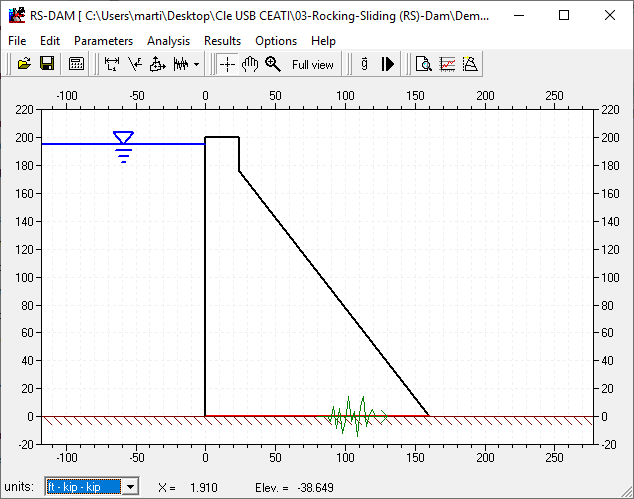
RS-DAM is a computer program that was primarily designed to provide a computational tool to evaluate the transient response of a completely cracked concrete dam section subjected to seismic loads. RS-DAM is also used to support research and development on structural behavior and safety of concrete dams.
RS-DAM is based on rigid body dynamic equilibrium. It performs a transient rocking and/or sliding analysis of a cracked dam section subjected to either base accelerations or time varying forces. Several modelling options have been included to allow users to explore the influence of parameters (e.g. geometry, additional masses, variation of the uplift force upon rotation, hydrodynamic pressures in translation (Westergaard) and rotation, center of rotation moving with sliding, coefficient of restitution of impact, etc...). RS-DAM is developed in a university context and has no commercial aspect.
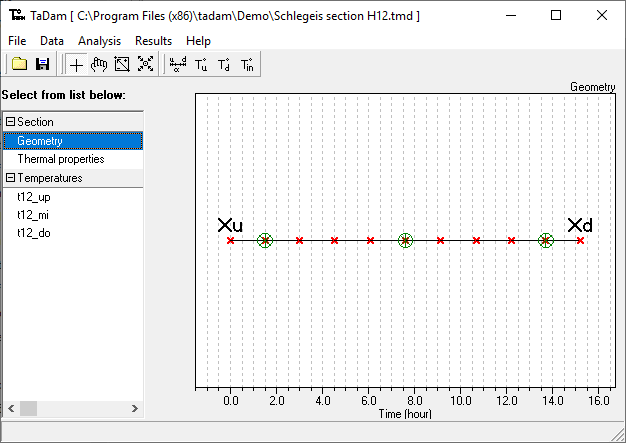
TADAM (Thermal Analysis of concrete DAMs) software employs a new frequency-domain solution technique to solve the 1D thermal transfer problem, allowing the calculation of temperature histories in a concrete dam section.
The direct solution calculates the evolution of the temperature distributions from the temperature histories of the upstream and downstream faces. The inverse solution uses temperature histories, measured inside the section, in order to calculate the temperature fields at the external faces, while taking into account the thermal wave attenuation effects and the phase angles along the section.
TADAM is developed in a university context and has no commercial aspect.