
For hardware and software requirements see this topic.
The term Guru Jilbab has also become pejorative among more conservative Salafi circles, who accuse these figures of riya’ (showing off) and lacking formal sanad (chain of religious knowledge). High-profile cases, such as the public feud between preachers like and Umi Pipik over the permissibility of using fake eyelashes, exemplify the contested nature of female religious authority. Detractors argue that a true guru does not monetize faith or prioritize viral content over scholarly rigor.
In the landscape of contemporary Indonesian Islam, the term "Guru Jilbab" (literally "Veiled Teacher" or "Jilbab Preacher") has emerged as a significant socioreligious archetype. Unlike traditional kyai or ustadz (male religious scholars), the Guru Jilbab typically refers to a female Islamic preacher who combines doctrinal authority with a distinct aesthetic of modesty, often amplified through social media platforms such as YouTube, Instagram, and TikTok. This paper argues that the Guru Jilbab phenomenon represents a double-edged sword: it facilitates the democratization of religious knowledge for Muslim women while simultaneously reinforcing patriarchal norms through the commodification of piety. guru jilbab
A defining characteristic of the Guru Jilbab is the performance of modesty as spectacle. Her perfectly draped pashmina or instan jilbab , flawless makeup, and curated background (often a minimalist, pastel-colored home studio) create an aesthetic of “effortless piety.” This visual branding is intimately tied to the Islamic fashion industry. Many Guru Jilbab figures are sponsored by hijab brands, halal cosmetics, or travel agencies offering umrah packages. Consequently, religious advice is interspersed with product endorsements, blurring the line between spiritual guidance and consumer lifestyle. As anthropologist Daromir Rudnyckyj argues, this creates a "market-driven piety" where salvation is symbolically purchased through modest fashion. The term Guru Jilbab has also become pejorative
Historically, female religious teachers in Indonesia—such as nyai (wives of kyai) or leaders of pesantren (Islamic boarding schools) for girls—operated within patriarchal hierarchies. Their authority was derivative of male scholars. However, the post-1998 Reformasi era, coupled with the rise of satellite television (e.g., MNC TV ’s "Hati ke Hati" with Mamah Dedeh), catalyzed the figure of the popular female preacher. The Guru Jilbab differs from her predecessors by deliberately branding her attire—specifically the jilbab (headscarf) and often the cadar (face veil) or loose gamis —as a symbol of both spiritual authenticity and middle-class respectability. In the landscape of contemporary Indonesian Islam, the
The Rise of the "Guru Jilbab": Piety, Performance, and Patriarchy in Indonesian Digital Da'wah
The primary function of the Guru Jilbab is pedagogical. She addresses issues often neglected by male preachers: menstruation ( fiqh wanita ), marital intimacy, child-rearing, and household finance. By reframing domesticity as a form of worship ( ibadah ), she provides practical religious guidance to millions of urban Muslim women. However, critics note that this pedagogy frequently centers on women’s obligation to obey husbands ( ta’at kepada suami ) and maintain family harmony ( sakinah ), thereby re-inscribing conservative gender roles.
The Guru Jilbab is a distinctly modern phenomenon—a product of Indonesia’s decentralized public sphere, digital capitalism, and enduring patriarchal structures. While she has empowered millions of women to access religious discourse outside the male-dominated majlis , her authority remains contingent on conforming to visual and behavioral codes of modesty. Ultimately, the Guru Jilbab does not dismantle the patriarchal hierarchy of Islamic knowledge; rather, she repackages it in a soft, feminine, and Instagrammable aesthetic. Future research must examine how these preachers navigate resistance from both progressive feminists (who critique their conservatism) and traditionalist ulama (who question their credentials).
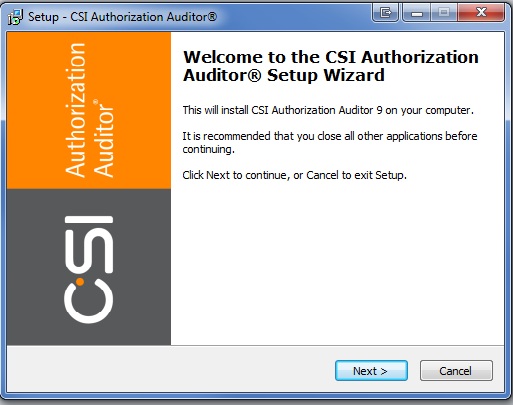
Click next on the welcome screen in order to continue.
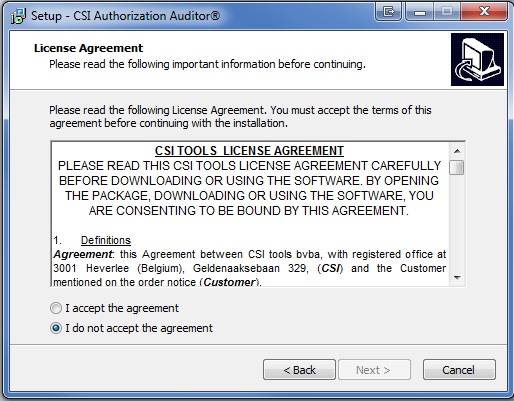
We advise you to read the license agreement before clicking 'I accept the agreement'. Click next to continue.
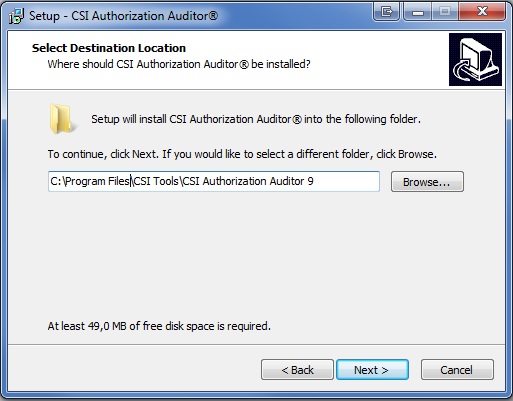
Choose a valid destination folder and click next. If the destination folder does not exist yet, a pop-up dialog asking you whether you want to create the directory will be displayed. Click next to continue.
Note: When installing the Access 2007 or 2010 version of the CSI Authorization Auditor, please make sure that the destination folder is a trusted location.
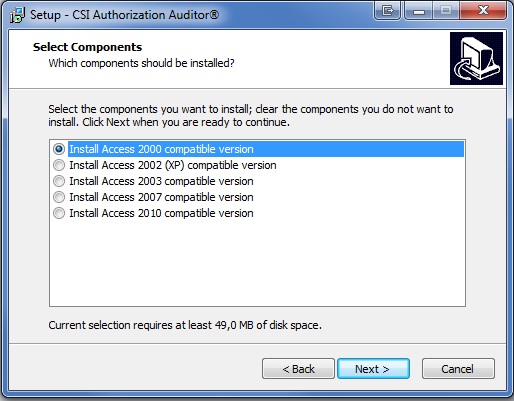
Select which Access-specific version of the CSI Authorization Auditor you wish to install.
Click next to continue.
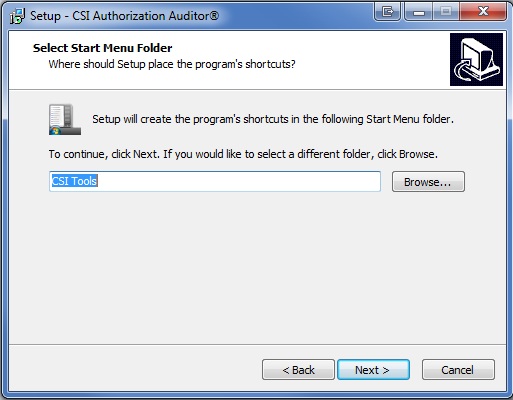
An entry in your start menu will be created. You can define the folder name which will be used.
We recommend that you leave this to the default 'CSI Tools' name. Click next to continue.
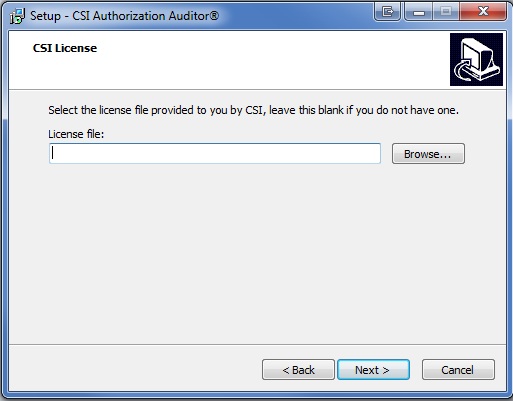
At this step you can browse for your license file which grants you access to your CSI Authorization Auditor. If you do not have this file at installation time, you can skip this step but keep in mind that you will need to link the license file at program startup before CSI Authorization Auditor will be functional.
Click next to continue.
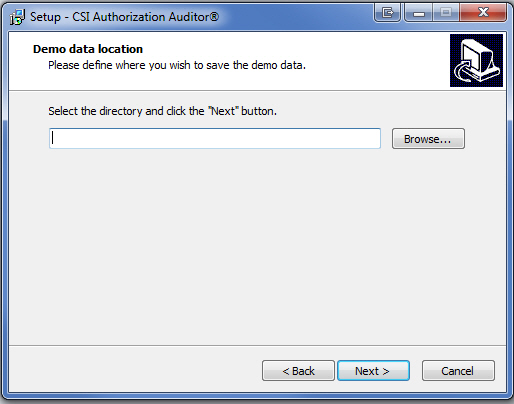
Please indicate the location where you wish to save the demo data which is provided when installing CSI Authorization Auditor.
We recommend to use a user-specific directory such as My Documents. A valid folder must be selected in order for the installation to proceed. Click next to continue.
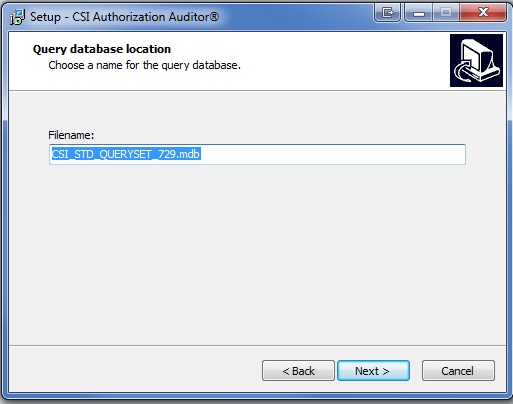
Please choose a name for the query database. Click next to continue.
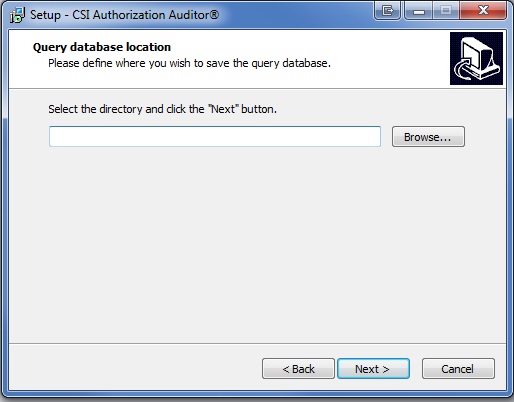
Please indicate the location where you wish to save your query database. We recommend to use a user-specific directory such as My Documents. A valid folder must be selected in order for the installation to proceed. Click next to continue.
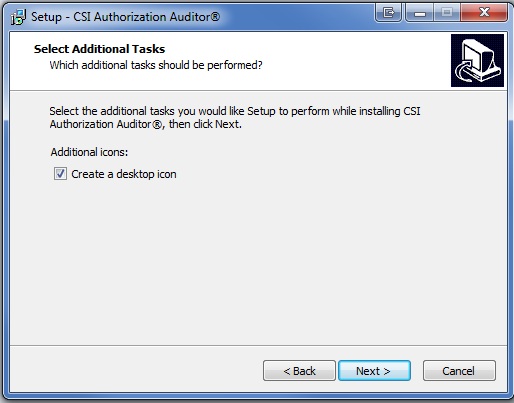
When desired the installation process can place a shortcut to the CSI Authorization Auditor on your desktop. Click next to continue.
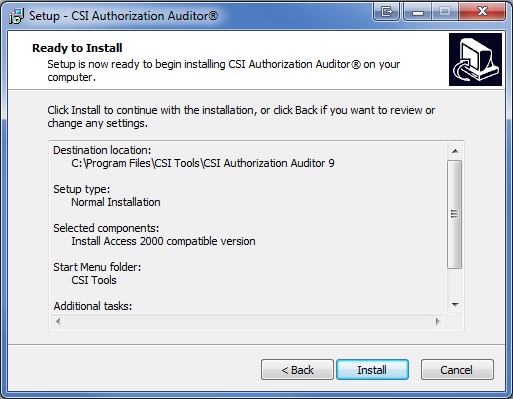
This part of the setup allows you to review the installation settings before the actual installation begins.
Click install to continue.
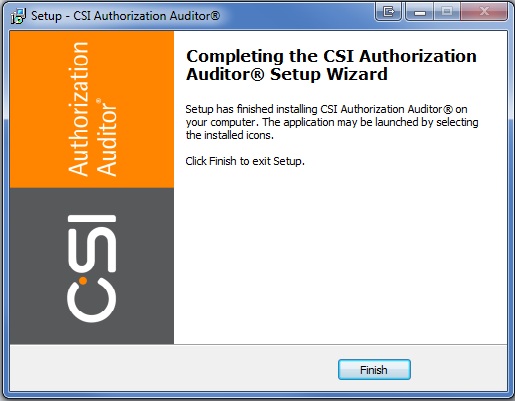
All files have now been copied and installed.
There are two ways to launch the CSI Authorization Auditor:
CSI tools BVBA © 2012 - All Rights Reserved